
Excel is one of the most useful tools ever built. It is flexible, familiar, and has kept businesses running for decades. The problem is not Excel. The problem is what happens when a growing Irish business tries to manage its entire operation through it.
There is a point where spreadsheets stop being a solution and start being the problem. Here are the top 5 signs your Irish business needs ERP.
1. Your Data Lives in Too Many Places
Finance has one version of the figures. Operations has another. Sales is working from a third. Nobody is completely sure which is current and reconciling them before a management meeting takes longer than the meeting itself.
When your business data is scattered across multiple spreadsheets, shared drives, and email threads, you do not have a single source of truth. You have a collection of interpretations, and decisions made on the wrong one carry real consequences.
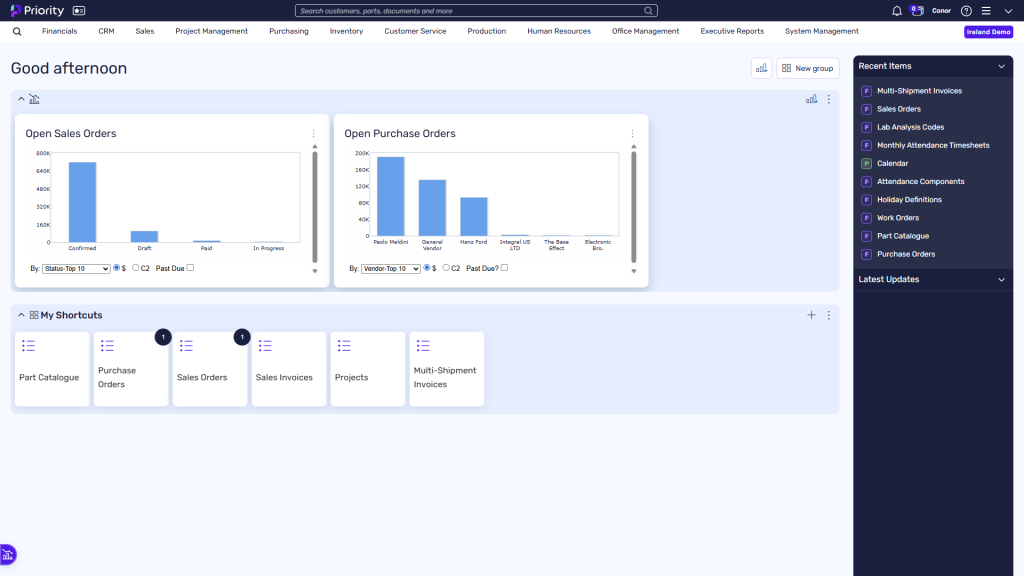
ERP brings everything into one system, giving you one version of stock levels, one view of customer orders, and one set of financials.

2. Reporting Eats Up Time Your Team Does Not Have
End of month becomes a scramble. Someone spends days pulling data from different spreadsheets, chasing figures from different departments, and building a report that has already started going stale before it lands in the boardroom.
That is not reporting. That is data archaeology. And it means your leadership team is making decisions based on a snapshot of last week rather than a view of right now.
With ERP, reporting is not a project. You run a report, the system pulls live data across finance, inventory, sales, and operations, and you have answers in minutes, not days.
The real cost of manual reporting is not just the hours. Your leadership team delays decisions, misses opportunities, and lets risks grow undetected until they become serious problems.
3. Human Error Is Becoming a Business Risk
When the same data gets entered in three different places, the chances of a mistake multiply with every copy and paste. n a spreadsheet, a wrong formula, a figure typed incorrectly, or a row that did not update is easy to miss and hard to trace.
In a business that relies on accurate inventory counts, precise financial records, or tight production schedules, those errors lead to overordering, under-invoicing, stock discrepancies, and compliance gaps.
ERP removes the duplication. You enter data once and it flows automatically across the system. You also get an audit trail, so when something does not look right, you can find out where it came from.

4. You Cannot See What Is Happening Right Now
Do you know your current stock levels without asking someone to check? Can you see which customer orders are overdue without opening four different files? Do you have a live view of your cash position, your production schedule, or your supplier lead times?
Break-fix visibility, checking things when something feels off, is a signal that your systems are behind your operations. By the time a problem surfaces, it has usually been building for a while.
ERP gives you real-time visibility across the business. ERP gives you real-time visibility across the business, pulling stock, orders, finance, production, and customer activity into one place and keeping it current. You stop finding out about problems after the damage is done.
5. Growth Is Creating Complexity Your Systems Cannot Handle
As the business grows, taking on more product lines, customers, and staff across more locations, the systems that once served you well start to buckle. Spreadsheets multiply, workarounds pile up, and new starters spend weeks trying to learn something nobody built to scale.
Growth should not mean more complexity. It should mean more capability. ERP scales with your business, handling increased volume, new processes, and additional users without requiring a new spreadsheet for every new challenge.
If your team is spending more time managing the system than using it, the system is the problem.

What ERP Gives You Instead
A well-implemented ERP system is not just software. It is a single operational backbone for your business. Finance, inventory, purchasing, sales, production, and reporting all connected, all current, all working from the same data.
For Irish businesses in manufacturing, distribution, warehousing, food production, and wholesale, that means tighter control, faster decisions, less waste, and the visibility to grow with confidence rather than with crossed fingers.
The right implementation partner will also take the time to understand your processes before recommending anything, map the gaps between how you work now and how the system can support you, and stay with you through go-live and beyond.
Is It Time to Move Beyond Spreadsheets?
If any of these signs feel familiar, let’s talk. We work with Irish businesses to assess where the gaps are, what ERP can realistically do for them, and how to move forward without disrupting the operation that is keeping the lights on today.
FAQs
How do I know if my Irish business is ready for ERP? If your team manages operations across multiple spreadsheets, struggles to get accurate data quickly, or finds that growth is creating more administration than capacity, ERP is worth a conversation.
Is ERP only for large businesses? No. ERP suits growing Irish SMEs in manufacturing, distribution, food production, warehousing, and wholesale. If your operations have outgrown spreadsheets, ERP brings the structure and visibility you need regardless of size.
How long does ERP implementation take? A focused implementation for an Irish SME can go live within a few months. The most important factor is preparation. Understanding your processes clearly before you start reduces disruption and speeds everything up.
Written by: Jolene Oelofse – Head of Marketing, myERP
Jolene leads myERP’s content strategy, translating complex ERP topics into practical insights for Irish manufacturing, aviation, and regulated organisations. She works closely with the ERP delivery team, including Sonya Browne, to ensure every article reflects real‑world system use and operational value.