Month-end close should not feel like a crisis. If your finance team is rebuilding figures from scratch every month, chasing numbers across departments, and reconciling spreadsheets that do not agree, the problem is not the people. It is the system.
Why does month-end close take so long for Irish manufacturers?
In manufacturing, distribution, and engineering businesses across Ireland, month-end is a bottleneck that nobody enjoys. The finance manager pulls data from the accounting system. Someone else exports from the stock management tool. The operations team sends a spreadsheet with production figures. Purchasing comes from somewhere else entirely.
None of these systems talk to each other. So, someone spends hours, sometimes days, pulling it all together, cross-referencing figures, and trying to explain why the numbers do not match. By the time the report lands on the MD’s desk, the data is already a week old.
The decisions being made on the back of that data are being made in the dark.
What changes when you move to an integrated ERP system?
An integrated ERP system means your finance team is not rebuilding the picture from scratch at the end of every month. The data is already there. Purchase orders flow into accounts payable automatically. Goods received update stock in real time. Production outputs post to the correct cost centres without manual intervention.
When month-end comes, the close becomes a process of reviewing and confirming, not assembling and chasing.
For a business that has been running on disconnected systems, this shift typically reduces month-end close time from several days to a matter of hours. Finance gets time back. Management gets accurate reports faster. And the business makes decisions on current information, not last month’s approximation.

How do you know if your business has outgrown its current system?
There are patterns that appear consistently in businesses that need ERP. If several of these sound familiar, you are not alone.
- Month-end takes three or more days and always involves at least one late evening
- Reports exist in multiple versions and teams are never sure which one is current
- Finance cannot see stock levels without calling the warehouse
- The MD asks a question about margin or cost per unit, and no one can answer without building a new spreadsheet
- Audits and compliance reviews require significant manual effort to gather the right documentation
- Sales and operations are working from different numbers
None of this is a people problem. It is what happens when a business outgrows the systems it started on.
What does ERP project management look like in practice?
The businesses that implement ERP well do not just close their books faster. They change how they run the entire operation.
Visibility replaces guesswork. Instead of finding out about a stock shortage when the shop floor calls, the operations manager sees it coming days in advance. Instead of waiting for month-end to understand margin, the commercial team has a live view at any point in the month.
Control replaces improvisation. Purchasing follows an approval workflow. Sales orders trigger stock allocation automatically. Invoicing is linked to delivery confirmation, so nothing falls through the gap between departments.
Time returns to the people who need it. Finance teams working on an integrated ERP system spend their time on analysis and forward planning, not data entry and reconciliation. For any business looking to scale, that shift is significant.

How do you choose the right ERP system for an Irish business?
The concern we hear most often from Irish businesses considering ERP is that choosing the wrong system, or the wrong implementation partner, will cost them more than staying put. It is a fair concern.
A good ERP implementation starts with understanding how your business works, not fitting your operations into a rigid template. It involves mapping your processes, configuring the system to match them, training your team properly, and providing ongoing support after go-live.
The right system depends on your industry, your processes, and where you want the business to go. The right partner asks those questions before they recommend anything.
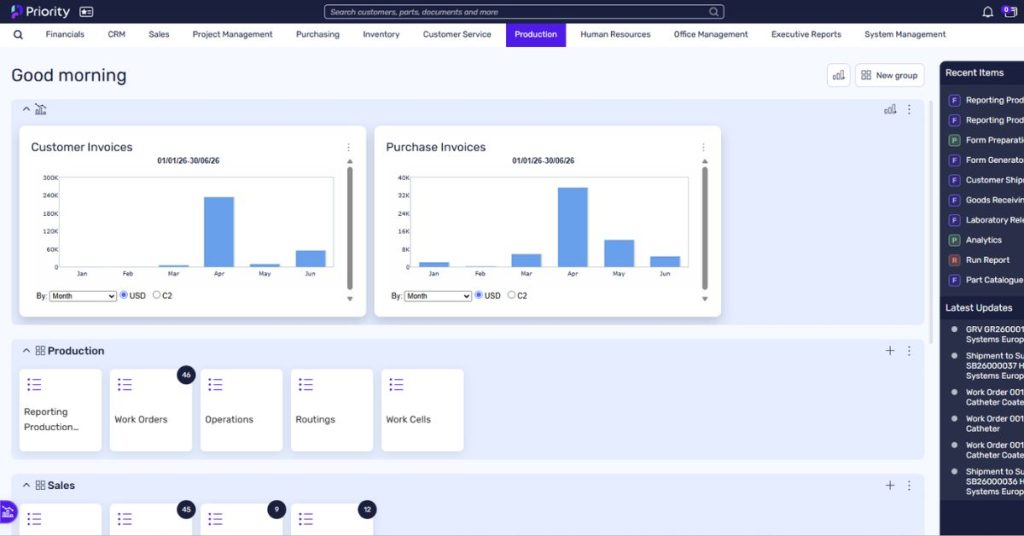
For Irish businesses in manufacturing, distribution, engineering, and logistics, Priority Software is one of the platforms we implement and support. It is a fully integrated system covering financials, supply chain, production, inventory, and CRM in one environment. See what our clients say about working with us on Priority ERP.
If your current system cannot answer basic operational questions in real time, it is worth understanding what an integrated ERP platform would look like for your business. The businesses that make the move consistently say the same thing afterwards. They wish they had done it sooner.