Irish food, drink and horticulture exports reached a record €19 billion in 2025, a rise of 12% on 2024. Behind every one of those pallets sits a batch number, a best before date, a recipe cost and a customer who wants answers fast. When those answers live in 4 spreadsheets and a notebook by the weighbridge, growth runs on luck.
ERP for food production brings every one of those answers into one live system. This guide explains what an ERP system does in a food business, what to look for when you compare systems, and 5 tests to run in every demo. myERP believes growth should run on clear figures, with luck left out of it.

What is the ERP system in the food industry?
An ERP system in the food industry is one connected system that tracks ingredients, recipes, production batches, stock, sales and finance from goods in to delivery. Every team works from the same live figures, so a buyer, a production manager and the finance team all see the same stock and the same costs. Traceability gives food businesses the strongest reason to connect their data. EU food law requires every food business to trace each ingredient back to its supplier and each product forward to its business customer. The Food Safety Authority of Ireland (FSAI) can ask for that information at any time. Consumers keep a close eye on food standards too. The FSAI received 6,135 consumer complaints in 2025, and 33% of them concerned unfit food, according to Food Safety News. A connected ERP system records each batch as it moves through the site. A recall, an audit or a retailer query then becomes a quick search, and the team spends its time on the next order.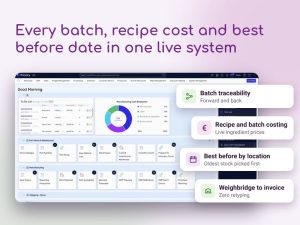
What is the best ERP system for food and beverage manufacturers?
The best ERP system for food and beverage manufacturers matches the way the business runs day to day, from the intake bay to the delivery van. Score every ERP for food production option on these 6 points.- Batch traceability, forward and back. Ask the system to trace one finished batch to every supplier lot inside it, and to every customer who received it.
- Recipe and batch costing. Ingredient prices move every month. Look for live recipe costs that update when a supplier price changes, so every quote protects your margin.
- Best before control by location. Short shelf life leaves little room for error. Check that the system shows best before dates by warehouse, chill store and van, and picks the oldest stock first.
- Weighbridge and scanner links. Weights, scans and dockets should flow straight into stock and invoices, with zero retyping. Read why weighbridge data drifts when systems sit apart.
- One live view of stock and cash. Finance, sales and the warehouse should see the same figures at the same moment, across every site.
- Local support and room to grow. Look for an Irish team that knows food production, and a modular system that adds sites, products and users as you grow.
What are some popular ERP systems for agriculture?
Popular ERP systems for agriculture handle the jobs that agri merchants, mills and suppliers run every day: weighbridge tickets, counter sales, credit control, stock and batch tracking. The right system joins all of these to the accounts, so the figures match at the end of every week. Mounsey Mills shows what that change looks like. The family-run agri business in Toomevara moved straight from pen and paper to Herbst Insight with myERP. Weighbridge tickets now feed directly into the system, stock updates instantly and Bob Mounsey sends 100+ invoices or statements in a single click. Batch traceability sits ready to switch on as the business grows. Bob puts it plainly: “Investing in myERP was the best decision I made for the business. It’s paid for itself, saved me time, improved control and helped everything run smoother.” Read the full Mounsey Mills case study.
How do you test an ERP system before you buy?
Test an ERP system before you buy by asking the provider to run your real food processes live in the demo. A clear, confident answer to each of these 5 tests shows the system can handle your busiest day.- Trace one finished batch back to every supplier lot, and forward to every customer.
- Cost one of your recipes using this week’s ingredient prices.
- Show best before dates for one product across every location.
- Post a weighbridge ticket or a scan straight through to stock and the invoice.
- Add a new product line or a new site, and show what changes.
Written by: Jolene Oelofse, Head of Marketing, myERP
Jolene translates complex ERP topics into practical insights for Irish manufacturing and operationally focused businesses, working closely with the ERP delivery team, including Sonya Browne, to keep every article grounded in real system use.