
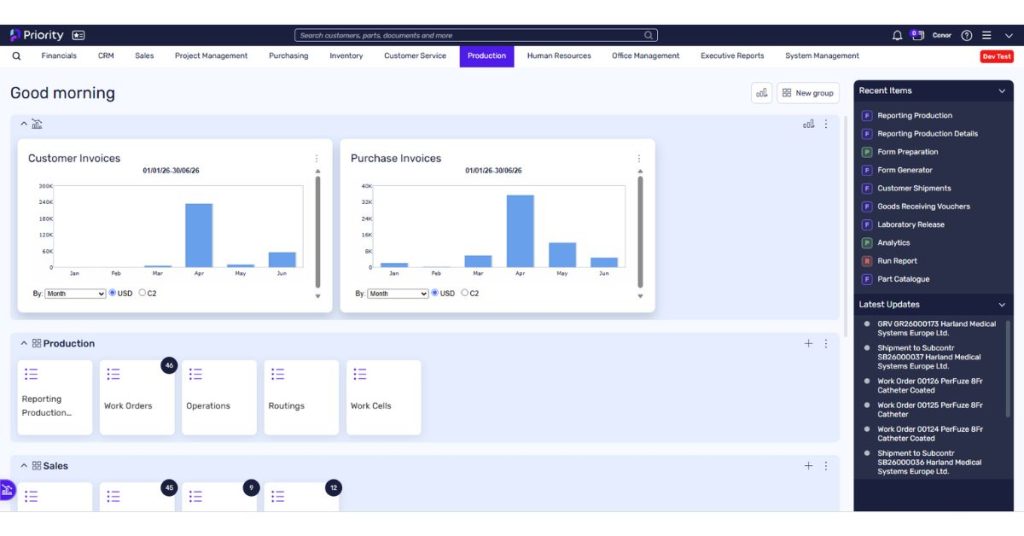
AI ERP financial close tools change what breaks first at month-end: the hunt behind the numbers, not the numbers themselves, chasing an invoice that landed in the wrong inbox, matching a bank transaction that will not line up, spotting a typo buried three sheets deep before it becomes a real problem. The close takes as long as it does because a team spends most of it searching, not analysing.
What slows down a manual month-end close?
Every business runs billing, payroll and banking through different tools, and someone has to pull them together by hand before a single report makes sense. That handover is where time disappears. A finance team ends up copying figures between systems instead of reviewing what those figures mean.
The errors that follow are small at first. A missed line item or a transposed number slips through quietly, and nobody notices until weeks later, when it shows up as an adjustment nobody can quite trace back to its source. By the time a report reaches leadership, the picture it shows is already out of date, built on numbers pulled together days or weeks earlier.
What does Priority’s aiERP solve at month-end?
Priority built aiERP around a simple idea: a finance team should be able to ask a question and get an answer, without digging through menus or spreadsheets to find it. Someone checking a customer balance or a cash position asks aiERP directly, in plain language, and gets a straight response.
The bigger shift happens behind the scenes. Priority’s V26.0 release taught the system to match transactions across banks, accounts and credit cards on its own, so a finance team reviews and confirms matches rather than hunting them down one by one. The system also catches the odd payment or the discount that looks out of place before it reaches a report, not after someone has already signed off on it.
What does a finance team gain once the close stops eating the month?
Time, mostly. Hours that used to disappear into chasing and checking go back into work that shapes decisions, forecasting, planning ahead, working out what a number means rather than confirming it is correct. Figures from different parts of the business come together automatically too, so a group-level number is ready the moment someone needs it, rather than several days later once everything has been pulled together by hand.
A finance team’s time is better spent on decisions than on chasing entries.
Request a personalised demo to see what this looks like for your business.
How does AI speed up the financial close?
Gartner predicts that finance organisations using cloud ERP applications with embedded AI assistants will see a 30% faster financial close by 2028, driven by automation in reconciliation, reporting and data validation that removes manual steps from the process.
What is the difference between an AI ERP and a traditional ERP?
A traditional ERP records transactions and leaves a person to review, reconcile and report on that data by hand. An AI-native ERP checks entries, matches transactions and flags anomalies as they happen, so a team spends its time reviewing rather than searching.
How can finance teams automate month-end reconciliation safely?
Safe automation keeps a full audit trail while the system handles the matching itself. Every match and every flag gets recorded, so a controller reviews what the system did rather than trusting it blindly.
Written by: Jolene Oelofse – Head of Marketing, myERP
Jolene leads myERP’s content strategy, translating complex ERP topics into practical insights for Irish manufacturing, aviation, and regulated organisations. She works closely with the ERP delivery team, including Sonya Browne, to ensure every article reflects real-world system use and operational value.